The Pipeline Model
SMLMAnalysis has one organizing idea: an analysis is an ordered list of typed step configs, and Julia's method dispatch routes each one to its implementation. Understanding that idea explains the whole package — why steps compose freely, why analyze() is the only verb you call, and why adding a step requires no change to the orchestrator.
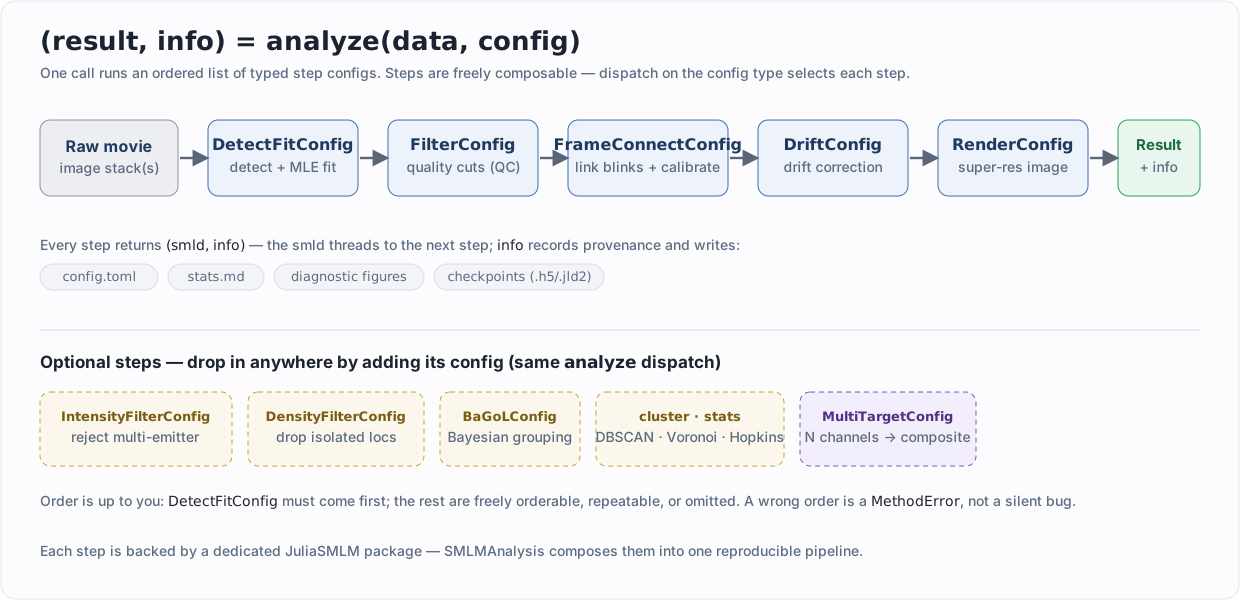
A pipeline is a vector of step configs
A localization pipeline is a sequence of transformations on a localization set. In SMLMAnalysis each transformation is a step, and each step is described by a typed configuration struct that subtypes SMLMData.AbstractSMLMConfig:
config = AnalysisConfig(
    camera = cam,
    steps = [
        DetectFitConfig(boxer = BoxerConfig(boxsize = 9, psf_sigma = 0.130),
                        fitter = GaussMLEConfig(psf_model = GaussianXYNBS())),
        FilterConfig(photons = (500.0, Inf)),
        FrameConnectConfig(max_frame_gap = 5),
        DriftConfig(degree = 2),
        RenderConfig(zoom = 20),
    ],
    outdir = "output/",
)
AnalysisConfig.steps is just a Vector{AbstractSMLMConfig}. The config carries what you want done and the parameters for each step; it carries no logic.
Dispatch is the router
The single verb is analyze. Calling analyze(state, cfg) dispatches on the types of both arguments — the current data state and the step cfg — to the right method. There is no step registry, no string lookup, and no if/elseif chain in the pipeline loop. The orchestrator is a plain fold:
state = image_stacks
for (i, cfg) in enumerate(steps)
    cfg = _prepare_step(cfg, camera)         # e.g. inject the camera into DetectFitConfig
    (state, step_info) = analyze(state, cfg; outdir, step_number = i, verbose)
    push!(step_infos, step_info)
end
Three consequences follow directly:
- Composability. The loop does not care what the steps are — only that
analyze()has a method for(typeof(state), typeof(cfg)). So steps can be reordered, repeated, or omitted freely. - Extensibility. Adding a step needs no change to the orchestrator. Define a config type and an
analyze()method and the step works — even from another package or your own script. See Extending the Pipeline. - Error clarity. A wrong order is a
MethodError, not a silent wrong answer.FilterConfigbefore anyDetectFitConfiggivesno method matching analyze(::Vector{…}, ::FilterConfig)— because filtering expects aBasicSMLD, and only detection produces one from raw images.
The tuple pattern: (result, info)
Every analyze() call returns a 2-tuple following the JuliaSMLM convention:
(result, info) = analyze(data, config)   # whole pipeline
(smld, info) = analyze(smld, cfg) # one step- The result becomes the input state for the next step. For most steps it is a
BasicSMLD; for the whole pipeline it is anAnalysisResult. - The info is the provenance: per-step it is a
StepInfowrapping the upstream package's own info struct; for the whole pipeline it is anAnalysisInfoaggregating them all. Nothing is hidden in globals — if a step computed it, it is on the returned info.
This is why you can run a pipeline in one call or step by step and get exactly the same per-step information either way.
State threading
The orchestrator threads one working smld through the steps: each step receives the current localizations and returns the updated set. Two pieces of state are captured from specific steps and surfaced on the final result:
result.smld_connected— the frame-connected tracks, fromFrameConnectConfig.result.drift_model— the fitted drift trajectory, fromDriftConfig.
The first step is special only in that it manufactures the initial smld:
DetectFitConfig (required first)
        │ produces the initial smld from raw images
        ▼
  ┌────────────────────────────────────┐
  │ FilterConfig          (0+ times)   │
  │ IntensityFilterConfig (0+ times)   │   any order,
  │ FrameConnectConfig    (0–1)        │   any combination —
  │ DriftConfig           (0–1)        │   dispatch doesn't
  │ DensityFilterConfig   (0+ times)   │   care, as long as
  │ BaGoLConfig           (0–1)        │   each step's input
  │ cluster configs       (0+ times)   │   type is satisfied
  │ RenderConfig          (0+ times)   │
  └────────────────────────────────────┘
The only hard constraint is that a DetectFitConfig comes first, because it is the only step that turns raw image stacks into a BasicSMLD; every other step consumes and returns an existing smld.
Repeatable and optional steps
Because dispatch — not a registry — drives the loop, multiplicity is free:
FilterConfig,RenderConfig,DensityFilterConfig,IntensityFilterConfig, and the cluster configs can appear any number of times (a coarse filter early and a tighter one after connection; several renders at different zooms; cluster then render the labels).FrameConnectConfigandDriftConfigare typically used once, but this is convention, not an enforced rule.
Uncertainty calibration is not a separate step — it is configured inside FrameConnectConfig via its calibration = field, runs as part of frame connection, and its results appear on FrameConnectInfo.calibration.
Two layers per step
Each step is implemented in two layers, which is worth knowing when reading the source or adding your own:
- An internal work function (not exported) that does the computation and returns
(result, <StepInfo>)— either implemented in SMLMAnalysis (e.g.filter_step) or delegated to an upstream package (e.g.SMLMDriftCorrection.driftcorrect). - A thin
analyze()method that times the call, wraps the result in aStepInfo, and returns the tuple. Its signature ends inkwargs...so the orchestrator can pass context keywords a step may ignore.
Where configs come from
Some step configs are defined in SMLMAnalysis; others are re-exported from the upstream package that owns them (the "upstream owns the config" idiom — a const alias, dispatched on directly).
| Config | Defined in | Notes |
|---|---|---|
DetectFitConfig | SMLMAnalysis | wraps SMLMBoxer + GaussMLE |
FilterConfig | SMLMAnalysis | native quality filtering |
IntensityFilterConfig | SMLMAnalysis | native Poisson multi-emitter rejection |
DensityFilterConfig | SMLMAnalysis | native neighbor filtering |
FrameConnectConfig / CalibrationConfig | SMLMFrameConnection | re-exported (CalibrationConfig is a sub-config, not a step) |
DriftConfig | SMLMDriftCorrection | re-exported |
RenderConfig | SMLMRender | re-exported |
BaGoLConfig | SMLMBaGoL | re-exported; step wraps run_bagol |
DBSCANConfig, VoronoiConfig, HopkinsConfig, … | SMLMClustering | re-exported; steps wrap cluster / cluster_statistics |
See The JuliaSMLM Ecosystem for what each upstream package does, and Data Model & Provenance for the types that flow between steps.