Pixel Indexing Convention
In Julia's image processing, we follow the array indexing convention where:
- Integers represent the center of pixels
- Arrays use
[y,x]indexing (row, column) - The top-left pixel is at coordinates
[1,1] yincreases downward (following matrix convention)xincreases rightward
Here's a visualization of the indexing convention for a 4×4 grid, together with the corresponding physical coordinates for a pixel size of 0.1 μm:
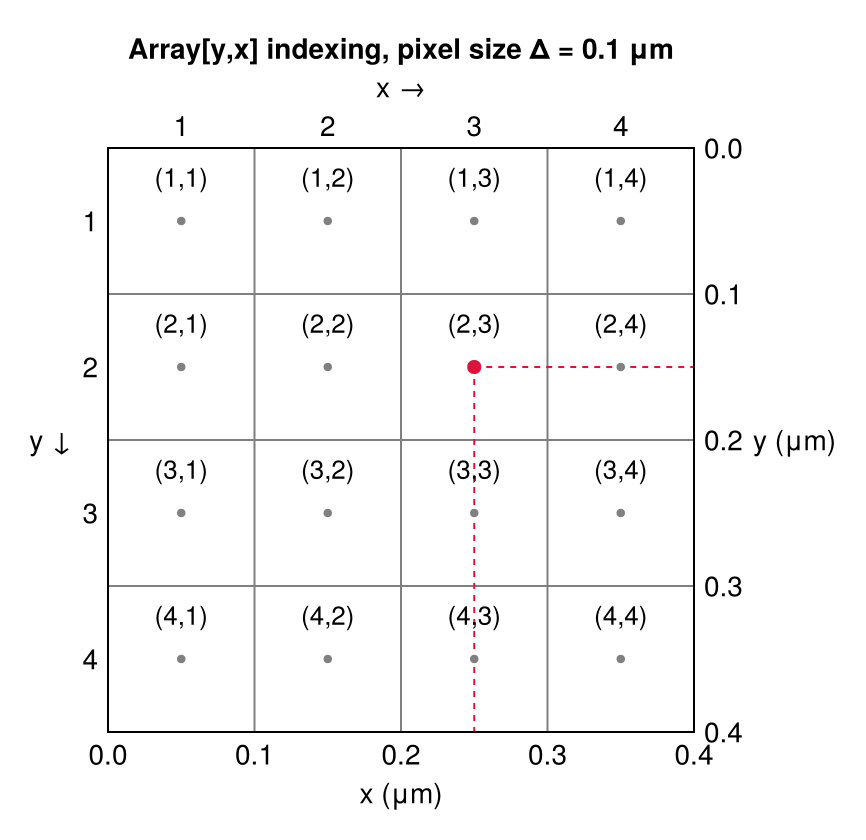
Each pixel is labeled with its (y,x) index: the top-left pixel is (1,1), y increases downward, and x increases rightward. Dots mark the pixel centers, which sit at integer pixel coordinates — pixel boundaries lie at the half-integers. The highlighted center of pixel (2,3) reads (x, y) = (0.25, 0.15) μm on the physical axes.
Physical units
Following the convention set by SMLMData.jl and used across the ecosystem:
- All spatial coordinates are in microns
- Physical space:
(0,0)is the top-left corner of the camera - Pixel space:
(1,1)is the center of the top-left pixel
With pixel size $\Delta$ (μm), pixel coordinates translate to physical coordinates as
\[x_{\text{phys}} = (x_{\text{px}} - 0.5)\,\Delta, \qquad y_{\text{phys}} = (y_{\text{px}} - 0.5)\,\Delta,\]
and back as $x_{\text{px}} = x_{\text{phys}}/\Delta + 0.5$. Pixel boundaries (half-integer pixel coordinates) therefore sit at integer multiples of $\Delta$, and the center of the top-left pixel is at $(0.5\,\Delta, 0.5\,\Delta)$.
SMLMData.jl exports these conversions as pixel_to_physical, physical_to_pixel, and physical_to_pixel_index (see the SMLMData API reference):
using SMLMData

pixel_to_physical(3, 2, 0.1)   # center of pixel [2,3] -> (0.25, 0.15) μm
physical_to_pixel(0.25, 0.15, 0.1)   # -> (3.0, 2.0)