Voronoi density
A cluster_statistics backend (selected by VoronoiDensityConfig) that reports each emitter's Voronoi cell area $A_i$ and its local density $\rho_i = 1/A_i$, intended as a feature for downstream thresholding (Otsu / GMM on $\log\rho$, a fixed cutoff, etc.). This is the read-only sibling of the Voronoi (SR-Tesseler) labeling backend: VoronoiConfig consumes the same per-emitter areas to assign clusters, whereas VoronoiDensityConfig only computes the density feature and assigns no cluster labels.
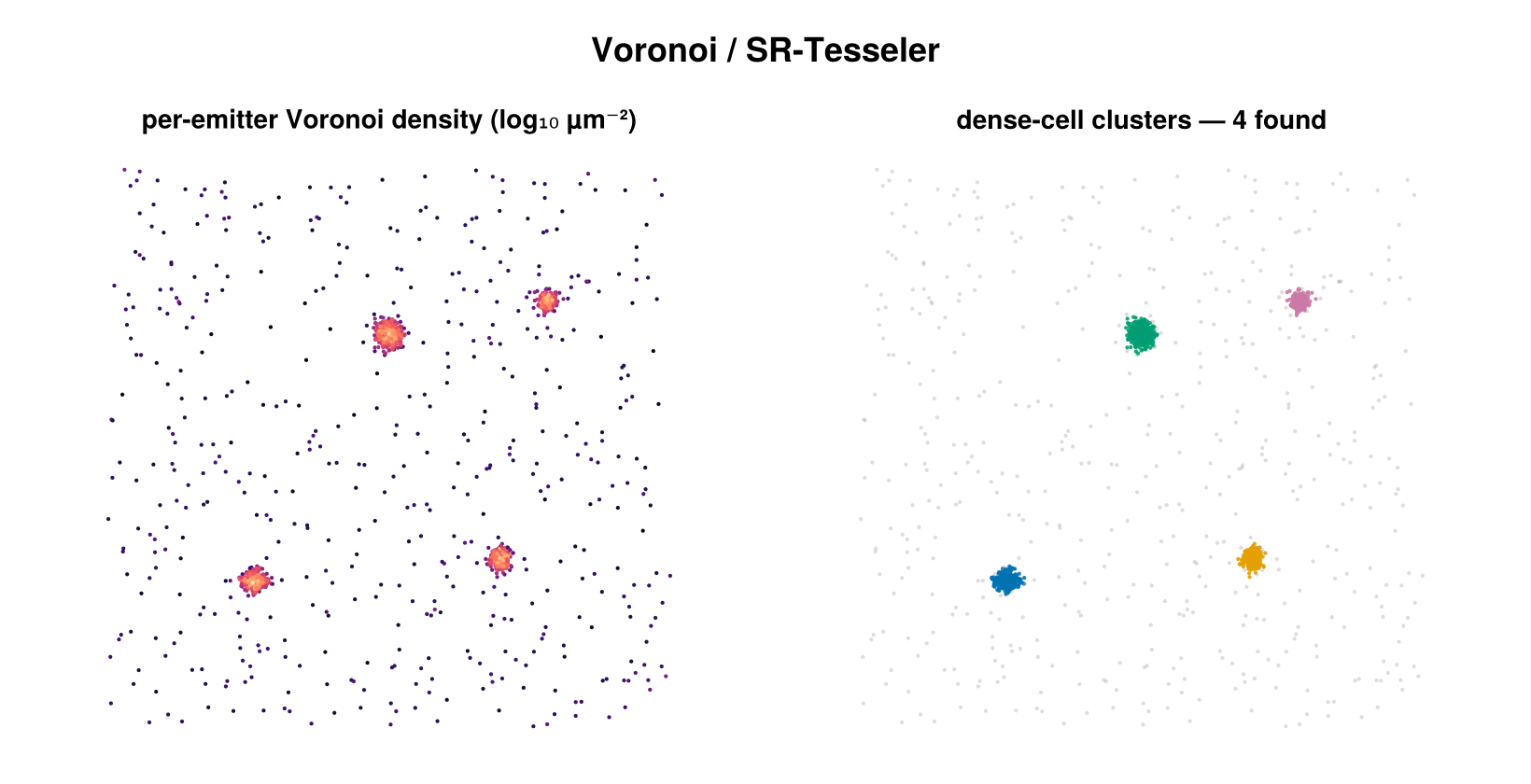
Left: the per-emitter Voronoi density feature this backend computes (bright = dense). Right: the same cell areas drive the SR-Tesseler labeling backend.
Concept
The Voronoi tessellation of a point set partitions the plane into one convex cell per generator — the region closer to that generator than to any other. The area of an emitter's cell is small where neighbors crowd in and large where they are sparse, so the cell area is a parameter-free inverse local-density estimate: $\rho_i = 1/A_i$. Unlike a fixed-radius or $k$-NN density, the cell adapts its own scale to the local point spacing, which is why Voronoi density is a robust density feature for the highly heterogeneous point clouds typical of SMLM. The usual use is cell-structure masking: separating dense membrane / structure regions from sparse background by thresholding $\log\rho$ (e.g. Otsu or a two-component GMM), as in SR-Tesseler.
How it works
For each group of emitters (one dataset when per_dataset = true, all emitters pooled otherwise), the backend builds the Voronoi tessellation of the emitter $(x, y)$ coordinates (in µm) using DelaunayTriangulation.jl. The tessellation is clipped to the convex hull of the group, so every generator receives a finite cell area (unbounded hull cells would otherwise have infinite area). For each emitter $i$ the cell area and density are
\[A_i = \operatorname{area}\bigl(\text{cell}_i\bigr) \;\; [\mu m^2], \qquad \rho_i = \frac{1}{A_i} \;\; [\mu m^{-2}].\]
Each group is tessellated independently; the per-group area and density vectors are then stitched back into the original (flat) emitter order, so the $i$-th entry always corresponds to smld.emitters[i] regardless of how the emitters were grouped. The summary scalar is the median density over all emitters that received a valid cell.
Configuration
VoronoiDensityConfig <: AbstractStatisticsConfig. Both fields are keyword arguments with defaults:
| field | default | unit | meaning |
|---|---|---|---|
use_3d | false | — | must be false; Voronoi tessellation is 2D only — true raises ArgumentError |
per_dataset | true | — | when true, tessellate each dataset independently; when false, pool all emitters into one tessellation. Per-emitter outputs stay flat in original emitter order in either case |
using SMLMClustering

cfg = VoronoiDensityConfig(
    use_3d      = false,    # 2D only — same constraint as VoronoiConfig
    per_dataset = true,     # tessellate each dataset independently
)
(_, info) = cluster_statistics(smld, cfg)

info.statistic        # median density across valid cells (Float64, µm⁻²)
info.statistic_name   # :median_density
info.algorithm        # :voronoi_density

ρ = info.extras[:density_per_emitter]   # Vector{Float64}, length == n_locs_in, µm⁻²
A = info.extras[:area_per_emitter]      # Vector{Float64}, length == n_locs_in, µm²

println("median density = ", round(info.statistic, digits = 2), " µm⁻²")
Output & interpretation
cluster_statistics returns (smld, info) where info is a ClusterStatisticsInfo. The SMLD is the same, unmodified reference as the input — this backend writes nothing onto it.
info.statistic— the median of all non-NaN per-emitter densities (statistic_name = :median_density), a single-number summary of overall density in µm⁻². It isNaNif no group produced any valid density.info.extras[:density_per_emitter]—Vector{Float64}of lengthn_locs_in, in µm⁻².info.extras[:area_per_emitter]—Vector{Float64}of lengthn_locs_in, in µm².
Both extras vectors are flat in original emitter order, not grouped by dataset: ρ[i] and A[i] correspond to smld.emitters[i]. Feed density_per_emitter (or log of it) into your own thresholding step — Otsu, a GMM split, or a fixed cutoff — to mask dense structure.
Notes & caveats
- 2D only.
use_3d = trueraisesArgumentError; DelaunayTriangulation.jl does not provide a 3D Voronoi tessellation. - Small groups. Any group with fewer than 3 points cannot be tessellated; those emitters receive
NaNdensity andNaNarea while other groups proceed normally. An empty SMLD yields empty extras vectors andstatistic = NaN. - Duplicate coordinates. A group containing exact-duplicate $(x, y)$ coordinates raises
ArgumentErrorbefore triangulation (duplicate generators are treated as a boundary-input issue, not a data-shape edge case — mirroringVoronoiConfig's guard). Deduplicate localizations beforehand. - Hull clipping. Because cells are clipped to the convex hull, emitters on or near the hull boundary have areas smaller than their infinite-plane Voronoi cell would be; their density is correspondingly higher than the interior trend.
References
- Levet, F. et al. SR-Tesseler: a method to segment and quantify localization-based super-resolution microscopy data. Nature Methods 12, 1065–1071 (2015). doi:10.1038/nmeth.3579 — Voronoi-based density estimation and segmentation for SMLM.
- DelaunayTriangulation.jl — the pure-Julia Delaunay/Voronoi engine used to build the tessellation.